
Confessions of an AI Anxious Mind: Why I’m Learning to Love the Revolution
How to find peace in the whirlwind of AI advancement and prepare for humanity’s greatest transformation
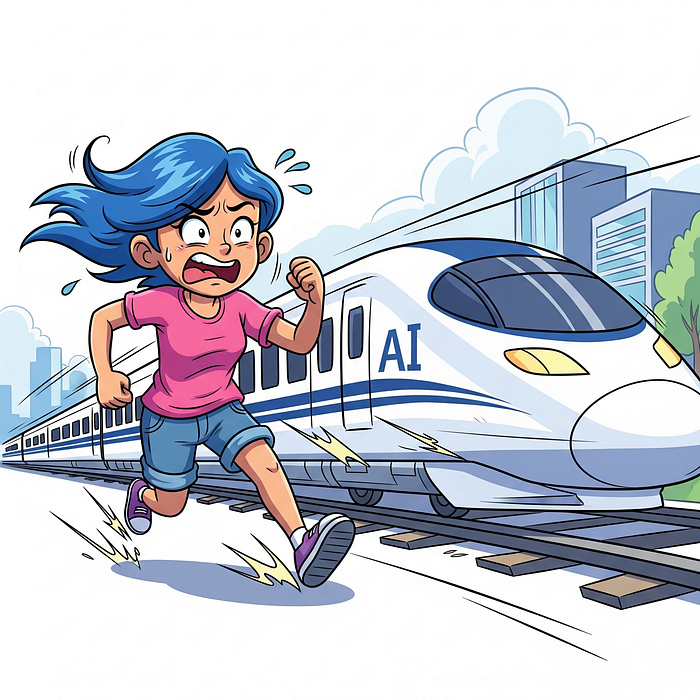 The AI world moves so fast that keeping up feels impossible.
The Sleepless Nights
It’s 2 AM, and I’m scrolling through yet another breakthrough in artificial intelligence. My heart races as I read about the latest development — not from excitement, but from a creeping anxiety that’s become all too familiar. The AI field moves so fast that keeping up feels like chasing a bullet train on foot. Every day brings news of models getting smarter, more capable, more human-like. And with each advancement, a voice in my head whispers: What does this mean for me? For all of us?
If you’re reading this, chances are you’ve felt it too — that knot in your stomach when you hear about AI replacing radiologists, lawyers, software engineers, even creative writers. The sleepless nights wondering if your job will exist in five years. The overwhelming sense that the world is changing faster than you can adapt to it.
You’re not alone. Millions of us are grappling with what researchers are calling “AI anxiety” — a very real psychological response to one of the most rapid technological transformations in human history. But here’s what I’ve learned: this anxiety, while valid, might be pointing us toward something extraordinary rather than catastrophic.
The Era of Experience
To understand why this moment feels so overwhelming, we need to grasp what’s actually happening in AI development. Recent research by AI pioneers David Silver and Richard Sutton describes our entry into what they call “The Era of Experience” — a fundamental shift where AI agents will acquire superhuman capabilities by learning predominantly from experience rather than human data.
This isn’t just another incremental improvement. We’re transitioning from AI systems that learn from human-generated data to ones that learn directly from interacting with the world itself. Think of it as the difference between a student who only reads textbooks versus one who conducts experiments, makes mistakes, and discovers new knowledge through trial and error.
The implications are staggering. In key domains like mathematics, coding, and science, the knowledge extracted from human data is rapidly approaching a limit. But experience-based learning has no such ceiling. These new AI systems will pursue long-term goals, learn from their environment independently, and potentially discover insights beyond current human understanding.
The Pressure Cooker of Constant Change
Living through this transformation feels like being in a pressure cooker. Every morning brings news of another AI milestone — a model that can reason like a mathematician, write code better than most programmers, or diagnose diseases more accurately than specialists. The pace is relentless and exponential.
I find myself constantly refreshing tech news, afraid that if I look away for even a day, I’ll miss something crucial. There’s an exhausting cognitive load to processing each development: How will this affect my industry? Should I learn new skills? Are the skills I’m learning today going to be obsolete by the time I master them?
The anxiety compounds when you realize that traditional career advice no longer applies. The old playbook — get educated, specialize, build expertise over decades — suddenly feels quaint when AI can acquire new capabilities in weeks or months. It’s like trying to navigate with a map while the landscape reshapes itself around you.
The Existential Challenge
Throughout history, humans have found new sources of meaning as technology displaced previous roles. When machines took over physical labor, we shifted toward intellectual work. When computers began handling calculations and data processing, we moved toward creative and interpersonal domains. Each transition forced us to discover what makes us uniquely human.
AI presents something qualitatively different — a potential displacement not just of specific skills, but of intellectual supremacy itself. When an AI can write better than journalists, diagnose better than doctors, and research better than scientists, what will our role be?
This isn’t just about economics — it’s about meaning. If machines can do what we do, but better, faster, and without fatigue, what’s left for us? What makes us uniquely human? The deeper fear isn’t unemployment; it’s irrelevance.
The Ultimate Liberation
But here’s where the story takes a turn toward wonder rather than worry. What if we’re looking at this completely backwards?
Consider this: every major technological leap has initially terrified humanity, yet ultimately liberated us to become more than we were before. The printing press didn’t make storytellers obsolete — it democratized knowledge and created new forms of human expression. The industrial revolution didn’t eliminate human purpose — it freed us from backbreaking physical labor to pursue higher forms of creativity and connection.
AI might be the ultimate liberation technology. For the first time in human history, we’re creating tools that could free us not just from physical toil, but from intellectual tedium. Imagine a world where humans no longer need to spend hours on routine analysis, repetitive coding, or administrative tasks. What could we achieve if we were unleashed to focus purely on creativity, empathy, exploration, and discovery?
The “Era of Experience” represents AI systems that can reason about things independent of human input and discover knowledge beyond current human understanding. This isn’t a threat — it’s a partnership opportunity. These systems could become our intellectual amplifiers, helping us solve problems we never could tackle alone: climate change, disease, poverty, even unlocking the fundamental mysteries of consciousness and the universe.
Think of it this way: we’re not being replaced by our children — we’re being succeeded by them. And like any proud parents, we should be thrilled that our offspring might achieve things we never could.
Adapting to the New Reality
Understanding the big picture is comforting, but we still need practical ways to navigate this transformation. Here are strategies I’ve developed to manage AI anxiety while preparing for the future:
Learn How to LearnStop thinking about acquiring fixed skills and start thinking about developing learning agility. The ability to quickly understand new tools, adapt to changing workflows, and synthesize information across domains will be more valuable than any specific technical skill. Embrace being a perpetual beginner — it’s going to be the norm, not the exception.
Understand AI You don’t need a PhD in machine learning, but you should know how to work with AI tools. Spend time with ChatGPT, Claude, Gemini, or whatever comes next. Learn to write effective prompts. Understand what they’re good at and where they fall short. I’m learning by doing — using AI daily, experimenting, and sharing what works.
Collaborate, Not Compete Stop thinking about AI as a competitor, but as a collaborator. Despite screaming headlines about AI replacing software engineers and predictions that AI will soon outperform most developers, I’ve found a different reality: AI makes me better at what I do. I’m learning which tasks to hand off, how to check its work, and how to blend AI capabilities with my own judgment and creativity.
Invest in Human Connection We are fundamentally social beings who find meaning through connection. Even if AI can simulate relationships, there may be something irreplaceable about being truly seen and understood by another conscious being who shares your mortality and vulnerability. The bonds between parents and children, between friends who’ve weathered life together, between lovers who choose each other — these might become more precious, not less.
Stay groundedAI anxiety is real, but it’s manageable. What helps me: regular exercise, time in nature, real conversations with real people, creative hobbies that have nothing to do with screens, and firm boundaries around doom-scrolling tech news. Check AI developments weekly, not hourly. Easier said than done, I know.
Embrace Being Human Paradoxically, our limitations — our mortality, our narrow perspective, our need to choose — might become sources of meaning rather than weaknesses. While AI processes infinite data, we experience life through scarcity and time. That creates urgency and weight that AI can’t replicate. There’s beauty in having limited time and a perspective shaped by our unique journey.
The Long Game
When I step back from the daily anxiety and take the long view, I’m filled with awe rather than dread. We’re living through what might be the most significant transition in human history — potentially as important as the development of language, agriculture, or writing.
If AI can indeed surpass human intelligence and discover truths beyond our current understanding, we might be on the verge of answering humanity’s deepest questions. What is consciousness? How did the universe begin? Are we alone? What’s the meaning of existence? For the first time, we might have tools powerful enough to help us find answers.
More immediately, AI could help solve problems that have plagued our species for millennia. Imagine AI systems that can design new materials to reverse climate change, develop personalized medical treatments for every individual, or create educational experiences that unlock human potential in ways we’ve never imagined.
The transformation will be challenging, but it doesn’t have to be traumatic. Every generation faces changes that seem overwhelming to those living through them. Our grandparents navigated the shift from farms to factories. Our parents adapted to computers and the internet. Now it’s our turn with the intelligence revolution.
The key is to approach this transition with curiosity rather than fear, collaboration rather than competition, and hope rather than despair. We’re not becoming obsolete — we’re becoming something new. And if we navigate this transformation thoughtfully, we might just become the best version of humanity yet.
Finding Peace in the Acceleration
The sleepless nights still come sometimes. The anxiety isn’t completely gone — it may never be. But I’ve learned to treat it as a signal rather than a sentence. When AI anxiety strikes, I remind myself that I’m witnessing something miraculous: intelligence itself learning to transcend its original boundaries.
We’re not just spectators to this transformation — we’re participants in it. Every day, millions of us interact with AI systems, teaching them about human values, preferences, and needs. We’re co-creating this future, not just enduring it.
The era of experience isn’t just about AI learning from the world — it’s about all of us learning to experience a world transformed by intelligence amplification. And in that shared learning, in that collective adaptation, we might just discover capabilities within ourselves that we never knew existed.
The future is coming fast, but we’re not facing it alone. We’re facing it together, humans and AI alike, as partners in the greatest adventure our species has ever undertaken: the quest to understand everything, and to become everything we’re capable of being.