
Finding Your Perfect AI Assistant: The Smart Way to Choose LLMs
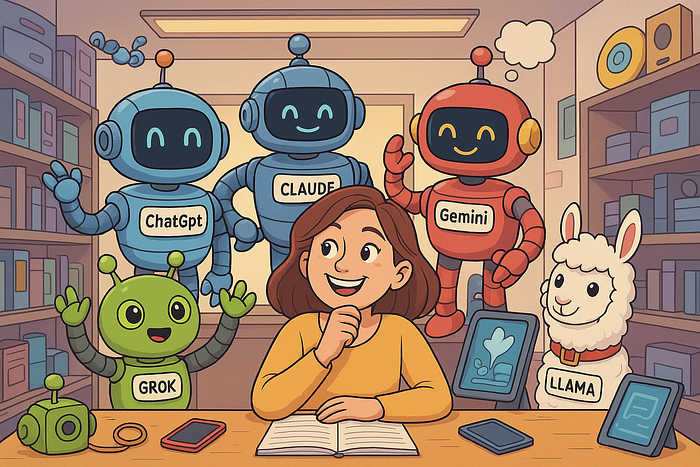
Picking an AI assistant shouldn’t feel like rocket science. But with GPT-4, Claude, Gemini, Grok, Llama, and dozens more popping up every month, it’s getting harder to know where to start. Here’s the thing: there’s no single “best” AI. What matters is finding the one that fits what you actually need to do.
Those Benchmark Scores Everyone Talks About
You know how restaurant reviews can be helpful but don’t always match your personal taste? AI benchmarks work the same way. They’re useful starting points, but they won’t tell you everything about how an AI will perform on your specific tasks.
The Benchmarks Worth Paying Attention To
MMLU-Pro takes the classic knowledge test and makes it harder — way harder. Instead of 4 answer choices, you get 10, and they only use the toughest questions. If a model scores above 50%, it’s doing pretty well, since most AIs see their scores drop significantly compared to the easier version.
GPQA Diamond is basically a collection of graduate-level science questions that would make most PhD students sweat. We’re talking 198 questions in physics, chemistry, and biology where even experts only get about 65% right, while smart non-experts with Google barely hit 34%.
Humanity’s Last Exam sounds dramatic because it is. Nearly 1,000 experts from over 500 institutions created 2,500 questions designed to push AI to its limits. These aren’t questions you can just Google — they require real understanding across more than 100 subjects.
LiveCodeBench keeps things fair by only using coding problems released after an AI’s training data was collected. No memorization allowed. It pulls fresh problems from LeetCode, AtCoder, and CodeForces, testing not just whether AI can write code, but whether it can debug, run tests, and predict outputs.
AIME uses real competition math problems that require genuine mathematical insight. These 15 questions come from a 3-hour test given to the top 5% of math students. Answers are integers from 0 to 999, so there’s no guessing your way through multiple choice.
MATH-500 cherry-picks 500 tough problems covering everything from algebra to probability. These aren’t just “solve for x” questions — they need multiple steps and clear mathematical reasoning to get right.
What to Choose Based on What You Do
If You Write for a Living
Claude 4 and GPT-4 are your top choices, but Claude 4 just raised the bar significantly.
When Claude Opus 4 launched in May 2025, it changed the writing game. According to Anthropic’s chief product officer, the output is now “unrecognizable from my writing” — and that’s a good thing. It handles most writing tasks independently without needing constant tweaking.
GPT-4 still rocks for structured content and when you need rock-solid factual accuracy. Claude 4 feels more natural and flows better, while GPT-4 gives you that dependable consistency.
Real scenario: You need product descriptions that actually convert browsers into buyers. Claude 4 writes copy that feels genuinely human and persuasive. GPT-4 nails structured content like blog posts and marketing materials. Go with Claude 4 when you want creative sophistication, or stick with GPT-4 for proven reliability.
If You Code (or Want to Learn)
Claude 4 is killing it right now, though GPT-4 is still solid, and Llama works great for specialized projects.
The numbers tell the story: Claude Opus 4 hits 72.5% on SWE-bench, while Claude Sonnet 4 edges even higher at 72.7%. Compare that to GPT-4.1’s 54.6% or Gemini 2.5 Pro’s 63.2%, and you can see why industry partners are calling it “state-of-the-art for coding.”
Here’s the kicker: Claude Sonnet 4 is available to free users. You’re getting frontier-level coding help without paying a dime. Claude also explains its code beautifully with clear, step-by-step reasoning. GPT-4 remains excellent for general coding and plays nice with more tools and services. Llama shines when you need to customize everything.
Real scenario: You want to build a web scraper. Claude 4 gives you working code with fewer bugs and explains exactly what each part does. GPT-4 delivers reliable solutions with great ecosystem support. Pick Claude 4 for cutting-edge performance or GPT-4 when you need something battle-tested.
If You’re All About Data and Research
For deep reasoning, Claude 4 is hard to beat. For broad knowledge, GPT-4.1 delivers. For anything involving images or videos, Gemini 2.5 Pro is your friend.
The top models — GPT-4.1 (90.2% MMLU), Claude 4 Opus (88.8% MMLU), and Gemini 2.5 Pro — all handle complex business problems well. Claude 4 particularly shines when you need extended reasoning or want to set up automated research workflows.
Gemini 2.5 Pro becomes essential when your data includes visuals. It scored 86.7% on AIME 2025 math problems and can process a million tokens at once — that’s entire documents, codebases, or hours of video.
Real scenario: Your boss wants insights from messy sales data that includes product photos and customer feedback videos. Gemini 2.5 Pro can analyze everything together in one go. Claude 4 gives you deeper strategic insights when you need to think through complex business decisions.
If You Need Current Information
Several options work here: Grok for X (Twitter) integration, ChatGPT Plus for structured research, Gemini for Google’s ecosystem.
Grok stands out with its personality and direct access to live X data. It doesn’t shy away from controversial topics and gives you real-time trending information. ChatGPT Plus offers web browsing and a Deep Research feature for comprehensive analysis. Gemini taps into Google Search. Claude doesn’t access real-time data at all.
Real scenario: You’re following a breaking news story. Grok shows you what people are saying on X right now. ChatGPT Plus creates structured research reports with citations. Gemini leverages Google’s search capabilities. Pick based on where you get your information and how you like it presented.
If You’re Building Customer Support
Claude 4 wins for safety and ethics, ChatGPT for integration options, Gemini if you’re already using Google Workspace.
Customer support is tricky — you need an AI that can handle conversations, stay safe, and remember context. Claude 4’s Constitutional AI principles and safety-first approach make it ideal for sensitive customer interactions. ChatGPT offers solid enterprise tools and API options for automation. Gemini integrates seamlessly with Google’s business tools.
Real scenario: A customer has a complex billing issue that’s been going on for weeks. Claude 4 keeps track of the context while providing measured, appropriate responses. ChatGPT plugs into your existing CRM. Gemini works perfectly if you’re already using Google Workspace for ticket management.
If You’re Creating Educational Content
Claude for safety, GPT-4 for comprehensive knowledge, Gemini when visuals matter.
Teaching requires accuracy and appropriate responses every single time. You want high MMLU scores for subject coverage and strong TruthfulQA scores to avoid spreading misinformation.
Claude’s safety training makes it naturally suited for education. But Gemini really shines when you’re working with visual content — diagrams, historical photos, scientific images, you name it.
Real scenario: Teaching biology with microscope images or history with primary source documents. Gemini analyzes and explains visual content alongside text, creating much richer learning experiences than text alone.
If You Need Total Control
Llama is your answer.
Open-source Llama models compete well on benchmarks while giving you complete control. Perfect for companies with specific requirements, privacy concerns, or unique use cases that commercial models can’t handle.
The catch? You need technical know-how to deploy and maintain it. But if you have that expertise, you can train it on your data, adjust its personality, and run it wherever you want.
Real scenario: A medical company needs an AI that understands their terminology and follows strict privacy laws. They can fine-tune Llama with medical literature and run it entirely on their own servers.
If Budget Is Tight
Look at Llama or smaller Gemini models.
Not everyone needs the Ferrari of AI models. Llama 2 and 3 variants deliver impressive performance without breaking the bank. Google’s smaller Gemini models provide solid capabilities at reasonable prices.
Real scenario: A startup needs a chatbot for their website. Llama 2–7B might not match GPT-4’s benchmark scores, but it handles customer questions just fine at a fraction of the cost.
My Four-Step Selection Process
After testing way too many models, here’s what actually works:
- Figure out your main thing: What will you use it for most? Writing? Coding? Analyzing data? Working with images?
- Check the right benchmarks: Don’t get lost in every score — just look at the ones that predict success for your specific needs.
- Think about your constraints: What’s your budget? Any privacy requirements? How technical is your team?
- Try it yourself: Benchmarks get you to the right neighborhood, but only real-world testing tells you if it’s the right fit.
Let’s Get Real for a Second
Benchmarks have their limits. Most use multiple-choice questions that don’t reflect how you’ll actually use AI. Some models basically study for the test, scoring high on benchmarks but disappointing when you need real work done.
I’ve seen models with identical scores perform totally differently on actual tasks. And let’s talk money — GPT-4’s amazing capabilities come with premium pricing. Claude offers excellent bang for your buck. Grok gives you those unique real-time features. Gemini excels with anything visual. Llama hands you the keys but expects you to know how to drive.
This field moves crazy fast. New benchmarks pop up constantly, trying to measure things we couldn’t even imagine last year. Stay curious, but don’t let analysis paralysis stop you from just picking something and getting started.
What Should You Do Right Now?
Use benchmarks to narrow down your options. Think about what makes each model special — Claude’s focus on safety, Grok’s real-time data, Gemini’s visual chops, Llama’s customization options. Then test your top picks with tasks that mirror your actual work.
The best AI for you isn’t the one with the highest scores or the fanciest features. It’s the one that makes your specific work easier, fits your budget, and delivers consistently when you need it.
You’re not just picking a tool — you’re choosing a work partner. Make sure it’s one that genuinely helps you get things done, not just one that looks good on paper.