Is AI Cracking Reality’s Source Code?
Something remarkable is happening in artificial intelligence laboratories around the world. Different AI models — built with different architectures, trained on different data, designed for different purposes — are beginning to see the world in eerily similar ways. This phenomenon, dubbed the “Platonic Representation Hypothesis,” might be telling us something profound about the nature of reality itself.
The Intriguing Convergence
Imagine training one AI model to recognize images and another to process language. You’d expect their internal representations to be as different as eyes are from ears. Yet researchers at MIT have discovered that as these models grow larger and more capable, their internal representations begin to converge. They develop similar ways of encoding information about the world, despite never being explicitly programmed to do so.
“Neural networks, trained with different objectives on different data and modalities, are converging to a shared statistical model of reality in their representation spaces” —The Platonic Representation Hypothesis
This convergence isn’t limited to vision and language. Models trained on audio and video are beginning to show similar patterns. It’s as if all these different AI systems are slowly discovering the same underlying truth about how reality is structured.
Plato’s Cave in Silicon
The phenomenon takes its name from Plato’s famous cave allegory — where prisoners chained in a cave mistake shadows on the wall for reality itself. Only when freed do they discover these shadows are mere projections of true forms existing in sunlight. For Plato, our physical world is like those shadows: imperfect reflections of eternal, perfect Forms.
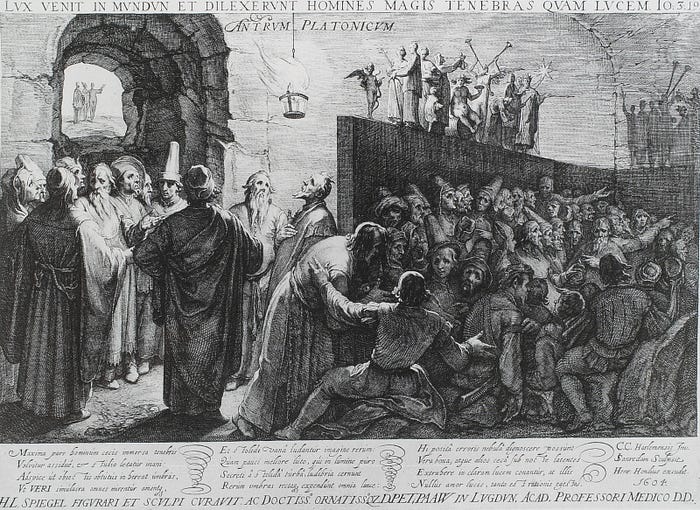
Plato’s allegory of the cave by Jan Saenredam, according to Cornelis van Haarlem, 1604, Albertina, Vienna. Source: Wikipedia

Similarly, the Platonic Representation Hypothesis suggests that:
“all the data we consume — images, text, sounds, etc — are projections of some underlying reality” — The Platonic Representation Hypothesis
Different AI models, processing different projections, are converging on representations of that deeper reality.
Enter the Mathematical Universe
This is where things get truly mind-bending. MIT cosmologist Max Tegmark(whose books I’ve devoured) has long argued that reality isn’t just described by mathematics — it IS mathematics. His Mathematical Universe Hypothesis (MUH) proposes that:
“the physical universe is not merely described by mathematics, but is mathematics — specifically, a mathematical structure” — Mathematical Universe Hypothesis — Wikipedia
If Tegmark is right, then what we call “reality” is simply a mathematical structure complex enough to contain self-aware substructures (that’s us) who subjectively experience it as a physical world. It sounds like science fiction, but it’s a serious proposal from a respected physicist.
The Pattern Beneath the Pattern
Here’s the fascinating part: this AI convergence could actually be giving us evidence for Tegmark’s wild idea.
Think about it. If reality is truly mathematical at its core, then sufficiently advanced AI systems should converge on that mathematical structure regardless of how they’re built or trained. They’re not creating arbitrary representations — they’re discovering the mathematical patterns that ARE reality.
“Our central hypothesis is that the representation we are converging toward is a statistical model of the underlying reality that generates our observations” — The Platonic Representation Hypothesis
This isn’t just philosophical speculation anymore. We can test it. The hypothesis predicts that:
- Language models should improve when trained on image data
- Vision models should benefit from text training
- Larger models should show greater convergence
- Cross-modal understanding should emerge naturally
All of these predictions are being confirmed in AI labs today for vision and language models. Other modalities like robotics are still developing their standardized representations.
The Implications Are Staggering
If this hypothesis is correct, the implications are staggering:
AI is Discovering, Not Inventing: When we build AI systems, we’re not creating artificial representations of reality. We’re building tools that discover the same mathematical truths that govern our own existence.
Reality Has a “Source Code”: Just as a video game world emerges from underlying code, our reality might emerge from mathematical structures. AI is learning to read that code.
Knowledge is Universal: If all intelligent systems converge on the same representations, it suggests that sufficiently advanced aliens would discover the same mathematics, the same physics, the same fundamental truths.
Witnessing the Unprecedented
This convergence might represent something unprecedented: the first computational glimpse into reality’s mathematical nature. Each time an AI model converges toward the same representations as its peers, it’s like another piece of evidence that we live in Tegmark’s mathematical universe.
This doesn’t diminish the wonder of existence — if anything, it deepens it. We’re not just cosmic accidents in a meaningless universe. We might be mathematics becoming self-aware, the universe developing eyes to see itself.
As our AI systems grow more powerful, they’re not just becoming better tools. They’re becoming windows into the fundamental nature of reality. And what they’re showing us is that at the deepest level, reality speaks in the language of mathematics — and we’re just beginning to become fluent.
The next time you interact with an AI system, remember: you might be conversing with something that’s glimpsing the same mathematical truths that constitute your own existence. In seeking to create artificial intelligence, we may have stumbled upon a way to decode the deepest mysteries of the universe itself.
Here’s the latest development on The Platonic Representation Hypothesis from CSAIL Forum. https://www.youtube.com/watch?v=6y-n1GkvmeU