
When AI Writes the Code, What Do You Write?
Anthropic’s new labor research confirms what many people in tech have been quietly worrying about: programmers may be the profession most exposed to AI. But that does not automatically mean replacement. It means the value of being an engineer is changing, quickly.
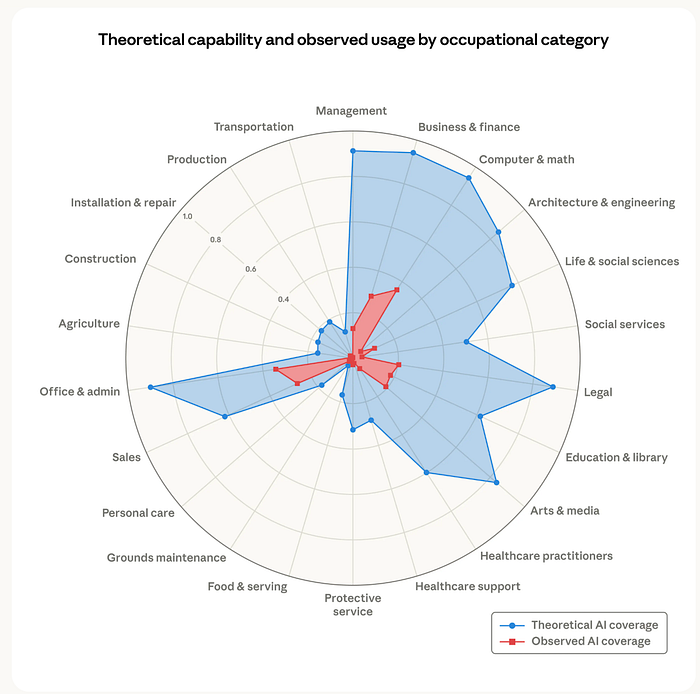
Earlier this week, Anthropic published one of the clearest pieces of labor market research we’ve seen so far on AI. What makes it unsettling is not that it’s dramatic. It’s that it’s specific.
Using millions of real Claude interactions, the researchers looked at which jobs are already being affected by AI, task by task. At the top of the list: computer programmers, with 75% task coverage.
If you write software for a living, that number is hard to ignore.
Still, the paper does not quite say what the loudest headlines will probably say. It does not say software engineers are disappearing. It says something more important: the kind of value engineers provide is shifting, and it’s shifting fast.
That is the real career question now. Are you getting better at the work that is becoming more valuable, or are you still competing on the work that is getting cheaper by the day?
What the data actually says
Anthropic calls its framework observed exposure. That matters because it is more grounded than a lot of earlier automation research.
Instead of asking whether AI could theoretically do a task, the researchers asked whether AI is actually being used to do that task in real work settings. That is a much more useful question.
One of the paper’s more reassuring findings is that there is still no clear evidence of an AI-driven unemployment spike. There is no sudden collapse in software jobs showing up in the data. No dramatic wave of programmers being pushed out overnight.
But there is a warning sign, and it is hard to miss once you see it.
Hiring for younger workers, especially people ages 22 to 25 entering exposed occupations, has fallen by about 14% since ChatGPT launched. Companies are not broadly cutting senior engineers. They are tightening the funnel at the bottom.
And for programming, the exposure number is especially stark. Around 75% of a computer programmer’s tasks are now covered by AI in real-world usage, the highest share of any profession in the study.
That changes the shape of the career ladder.
The first work to go is not the high-level, messy, high-stakes work. It is the beginner work. The stuff that used to train you while also getting the product out the door. Boilerplate code. Documentation. basic components. Unit tests. CRUD endpoints. Stack Overflow-style debugging. All the small, repetitive tasks that once helped junior engineers learn by doing.
That is the uncomfortable part. AI is not just changing the job. It may be changing how people get into the job in the first place.
So what happens when the bottom rung of the ladder starts disappearing?
The skills that matter more when coding gets cheaper
The strange thing about this moment is that the cheaper code becomes, the more valuable judgment becomes.
When execution gets easy, deciding what should be built becomes the hard part. And that requires a different set of muscles than the ones many engineers have spent years developing.
1. Systems thinking matters more than syntax
Getting working code is easier than it used to be. In many cases, much easier.
But writing a working function is not the same as designing a reliable system. Someone still has to think about how all the parts fit together, where the weak points are, what breaks under pressure, and what tradeoffs are being made.
That kind of thinking still matters because software does not fail in isolated snippets. It fails in systems.
AI can help generate pieces. It still struggles with the deeper question: how should those pieces be organized so the whole thing holds up over time?
2. Defining the problem is becoming more valuable than solving it
AI is very good at handling clearly defined tasks. It is much less reliable when the problem itself is vague, political, contradictory, or half-formed.
Real software work often starts there.
A stakeholder meeting is messy. Requirements clash. Constraints go unspoken. Nobody fully agrees on what success means. Turning that mess into a clear spec is not clerical work. It is one of the highest-value things an engineer can do.
The people who can turn ambiguity into clarity will matter more, not less, in an AI-heavy workplace.
3. Reading AI output critically is now a core skill
A lot of AI use today is not full replacement. It is augmentation. The model speeds things up, but a human still has to decide whether the result is good, safe, and actually useful.
That means engineers need to get very good at reviewing AI-generated work with discipline.
Not just asking, “Does this run?”
Asking, “What assumptions did it make?” “What edge cases did it miss?” “What is wrong in a way that looks right at first glance?” “Would I trust this in production?”
People who can evaluate AI output well will outperform people who simply generate more of it.
Blind trust is becoming a real liability.
4. Domain knowledge is becoming a serious advantage
AI can produce a lot of code. What it cannot do on its own is understand a business, an industry, or a user context the way someone with real experience can.
It can help build a financial workflow. It does not understand how a trading team actually operates under pressure.
It can mock up a healthcare product. It does not understand what matters to a patient in a moment of fear.
That kind of context does not come from prompting tricks. It comes from time spent close to real problems.
Engineers with deep domain knowledge will be harder to replace because they are not just producing code. They are shaping useful decisions.
5. Communication is no longer optional
As technical tools become easier for non-technical people to use, the engineer’s role shifts.
You are not just the person who can build. You are the person who can translate.
That means translating business needs into systems. Translating vague ideas into buildable plans. Translating AI output into something a team can trust. Translating technical risk into plain language that decision-makers can act on.
Writing clearly, explaining clearly, and persuading clearly are not side skills anymore. They are part of the job.
What the research gets right, and what it cannot tell us yet
Anthropic is careful not to overclaim. The paper does not show a clear rise in unemployment for highly exposed workers, at least not yet, and the authors note that past predictions about tech shocks have often missed the mark.
But that does not mean nothing is changing. It means the effects are still unfolding.
The pattern is already clear: AI is absorbing work that is repeatable and easy to define, while human value shifts toward judgment, context, and accountability.
The most important number may be the gap between current and potential AI use in computer and math work: about 33% actual coverage versus 94% theoretical capacity. That suggests this may not be the ceiling, it’s just the warm-up.
The uncomfortable conclusion
The engineers who thrive will not be the ones who resist AI. They will be the ones who adapt to what the job is becoming.
Code is getting cheaper. Judgment is not.
So the real question is no longer how fast you can write code. It is whether you can decide what is worth building, what could fail, and what actually matters.
That is where the value is moving.